

A bare fence does its job, but it rarely adds much to a garden. It marks the boundary, it gives you privacy, and then it just sits there, season after season. The quickest way to change that feeling — without rebuilding anything — is to dress it in green. When people start searching for the best climbing plants for fences, they are usually hoping for exactly that transformation: softer lines, more colour, more scent, and a boundary that feels like part of the garden instead of an edge where the garden stops.
Climbers are wonderfully economical plants. Because they grow up rather than out, they give you a large, mature-looking plant in a surprisingly small footprint of soil. A single clematis or honeysuckle planted in a narrow border can cover several panels in a few seasons, cool a sunny boundary in summer, and give birds and pollinators somewhere to feed and shelter. In a small garden, that vertical space is often the biggest unused asset you have.
There is no single perfect climber for every fence, though. The right choice depends on how much sun the fence gets, whether you want leaves all year or flowers are the priority, how fast you need cover, and how much tying in and pruning you are happy to do. This guide walks through the most reliable options, explains how each one actually climbs — because that decides what support it needs — and shows you how to plant and train them so they cover the fence evenly instead of piling up in one leafy lump at the top.
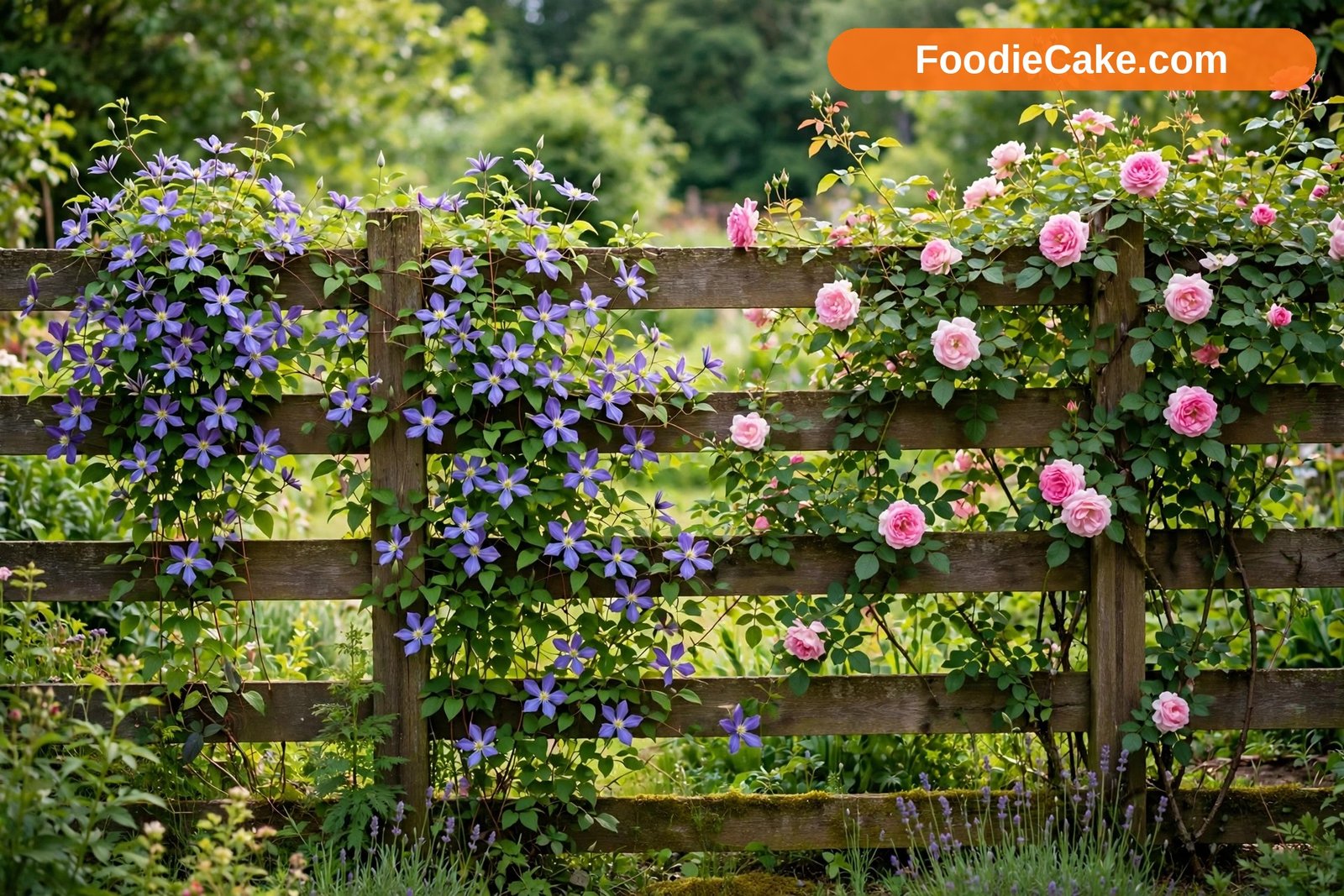
Choosing the Right Climber for Your Fence
Before you fall for a photograph of a rose-smothered fence, take an honest look at your own. Walk the boundary at different times of day and note which sections sit in full sun, which get a few hours, and which stay in shade. Most flowering climbers, including roses and most clematis, flower best with at least six hours of sun, while a handful — climbing hydrangea, many honeysuckles, and ivy among them — cope well with a north- or east-facing fence that gets gentler light.
Next, think about how the plant climbs, because climbers use completely different methods. Twining plants such as honeysuckle, jasmine, and morning glory wrap their stems around whatever they find. Tendril climbers like clematis and sweet peas reach out with thin, curling tendrils that need something slender to grip — wire, netting, or thin canes work far better than a solid panel. Scramblers such as climbing roses do not really climb at all; they produce long, flexible stems that lean and push through shrubs, and on a fence they rely entirely on you to tie them in. Self-clinging plants, including ivy and Virginia creeper, attach themselves with tiny roots or sticky pads and need no support, but that same grip makes them the hardest to remove later.
Evergreen or deciduous matters, too. An evergreen climber like star jasmine gives you a green, private screen in January as well as July. A deciduous plant loses its leaves in winter, which can be a drawback for privacy but a bonus if you want winter sun to reach the border behind it. Many gardeners mix the two: one evergreen for year-round structure, with a deciduous flowering climber growing through it for seasonal colour.
Finally, be realistic about vigour. A wisteria or a rambling rose can eventually cover a house, let alone a fence, and will overwhelm a short run of panels in a small garden. On a typical six-foot fence, medium-sized climbers that reach eight to fifteen feet are usually the sweet spot — large enough to cover well, small enough to keep in bounds with one good prune a year.
Clematis: Colour From Spring to Autumn
If you want the longest flowering season from a single plant, clematis is hard to beat. There are varieties that open in early spring, varieties that peak in midsummer, and late types that flower into autumn, and by choosing two or three with different seasons you can have a fence in flower for much of the year. Flowers range from delicate, nodding bells to huge, flat stars in white, pink, red, purple, and blue.
Clematis climb by twining their leaf stalks around supports, and those stalks are slender. A solid fence panel gives them nothing to hold, so fix horizontal wires, a section of trellis, or plastic mesh to the fence first, spaced roughly a foot to eighteen inches apart. In zones 5–8, most large-flowered hybrids are reliably hardy; in colder areas, the late-flowering viticella types are a safer bet because they flower on new growth, so winter damage matters far less — you simply cut them back hard in late winter and they start again.
The old rule for clematis is “head in the sun, feet in the shade.” Plant the crown a few inches deeper than it sat in its pot, water deeply, and shade the base with low plants, a tile, or a thick mulch so the roots stay cool and moist. That deep planting also helps the plant reshoot if stems are damaged. Pruning confuses many beginners, but it boils down to timing: spring flowerers are pruned lightly after flowering, if at all, while late flowerers can be cut to about a foot from the ground in late winter. If you buy named varieties, keep the label — knowing which group yours belongs to makes pruning a two-minute decision instead of a worry.
Clematis pairs beautifully with other climbers. Growing one through a climbing rose is a classic combination: the rose gives the structure, the clematis adds a second wave of colour, and both are happy being tied to the same wires.
Climbing Roses: Classic, Scented, and Generous
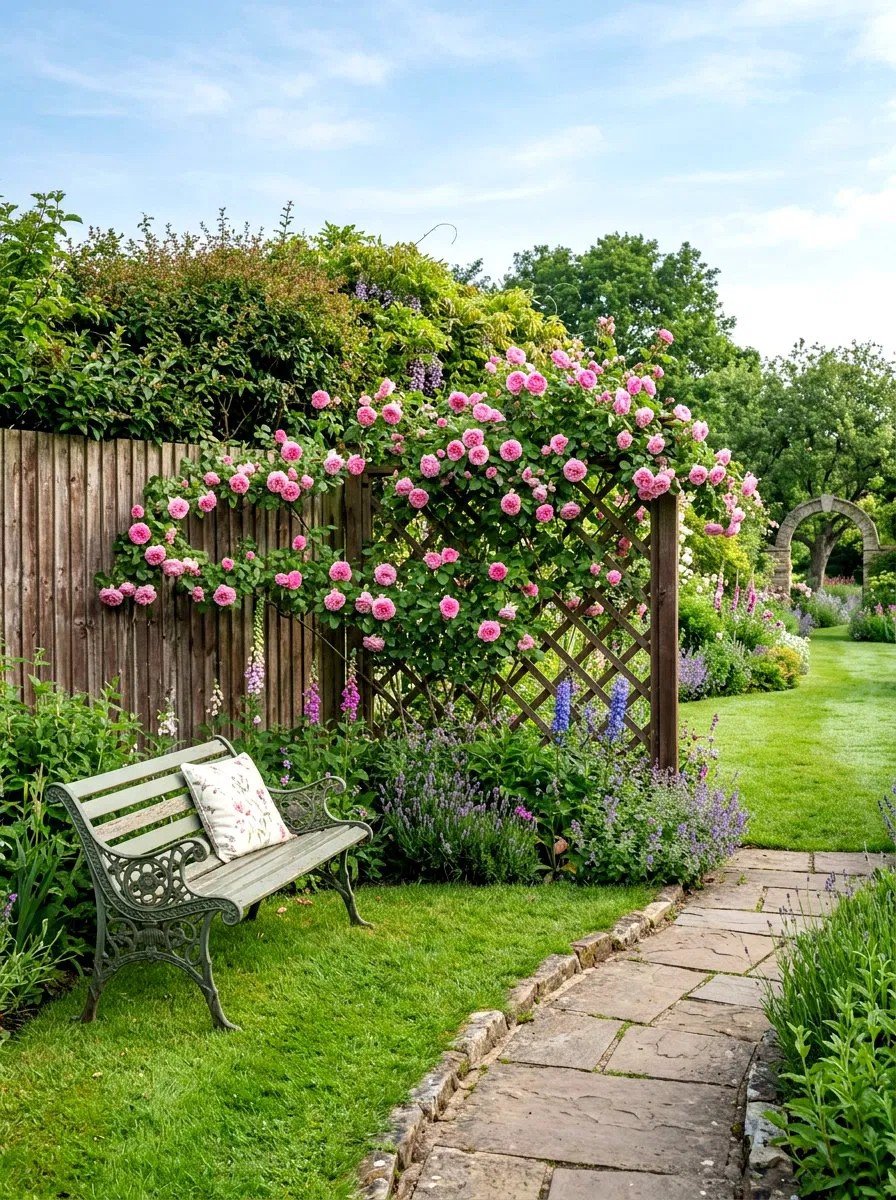
A climbing rose on a sunny fence is the picture most of us carry in our heads, and modern varieties make it far easier than it used to be. Look for repeat-flowering climbers rather than once-a-year ramblers if your fence is modest in size. Ramblers are glorious — and enormous. A repeat climber reaching ten to twelve feet will cover two or three panels, flower in flushes from early summer into autumn in zones 5–9, and leave room for other plants besides.
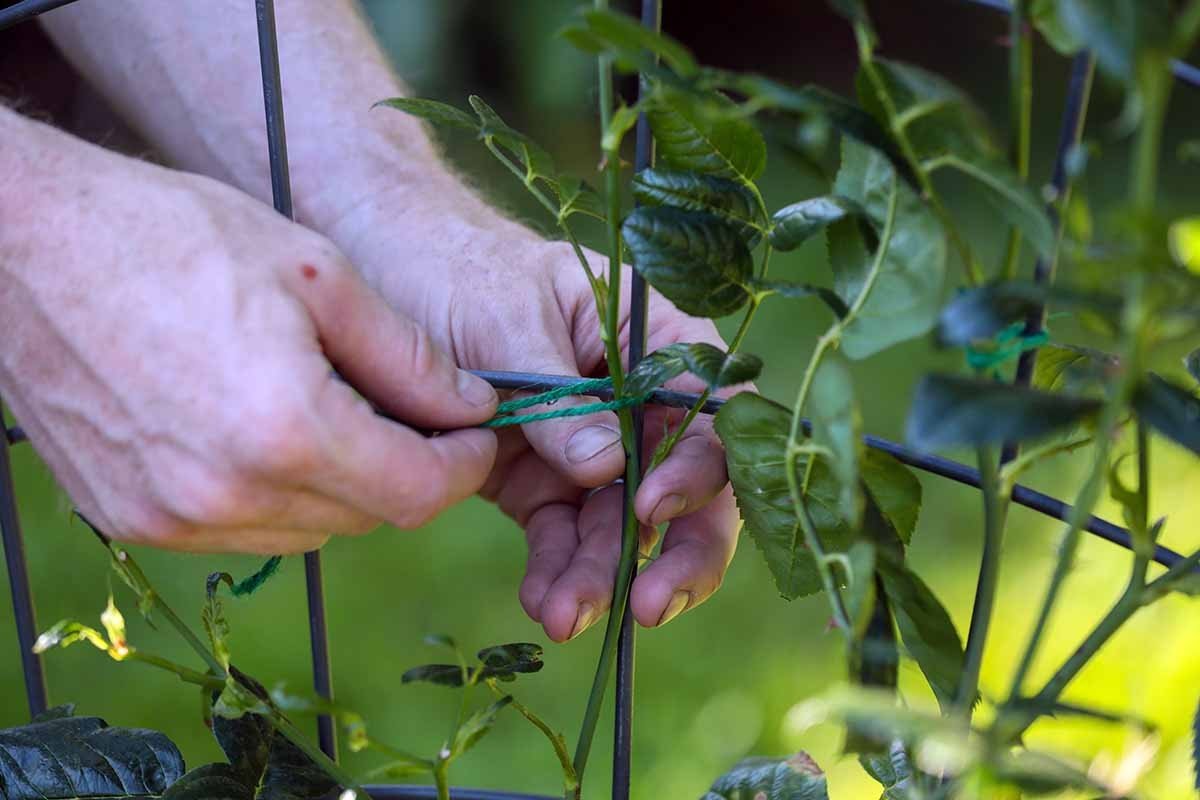
Roses do not climb by themselves, so support and training decide how well they flower. Fix strong horizontal wires to the fence, the first about eighteen inches from the ground and then every foot or so above. As the long stems grow, tie them in as close to horizontal as you can manage without snapping them. This feels counterintuitive when you want height, but a stem trained sideways breaks into many short, upright, flowering shoots along its length, while a stem left to grow straight up flowers mostly at the tip. That single habit — fan the stems out like the ribs of a fan — is the difference between a fence sprinkled with roses and a fence covered in them.
Plant roses in autumn or early spring in mild areas, and in spring where winters are severe. Dig a generous hole, mix in compost, water well through the first season, and mulch each spring. If you enjoy raising your own plants, learning how to grow roses from cuttings is a satisfying way to multiply a favourite variety for another stretch of fence. Watch for black spot in wet summers: space plants for air flow, water at the base rather than overhead, and clear fallen leaves in autumn.
Choose scented varieties if the fence borders a path or seating area. A fragrant climber by a bench, where you brush past it daily, earns its place in a way a prettier but scentless flower never quite does.
Star Jasmine and Other Evergreen Options
When privacy through the winter matters most, evergreen climbers earn their keep. Star jasmine is the standout for a sunny or lightly shaded fence in zones 8–10, and in sheltered spots in zone 7. Its glossy, dark green leaves turn bronze-red in cold weather, and in early summer it covers itself in small, white, pinwheel flowers with a sweet scent that carries across the garden in the evening. It twines, slowly at first — expect a quiet first year or two — then steadily, and it responds well to a light trim after flowering to keep it hugging the fence.
In cooler climates, ivy is the dependable evergreen, though it comes with warnings covered below. A happier middle option for zones 6–9 is evergreen honeysuckle, which keeps many of its leaves in mild winters and flowers over a long season. Climbing hydrangea, while deciduous, holds its shape against a shady fence better than most, with lacy white flowers in early summer and attractive peeling bark in winter; it is slow to establish, sometimes taking a few years to get going, then climbs happily on a north-facing fence where little else will flower.
Evergreens also shelter wildlife through the cold months, and dense growth on a fence can be a roosting spot for small birds. The trade-off is weight and shade: a mature evergreen climber is heavy and casts deep shade at its base, so underplant with shade-tolerant bulbs and ground cover rather than sun-lovers that will quietly fail.
Honeysuckle and Passion Flower for Wildlife
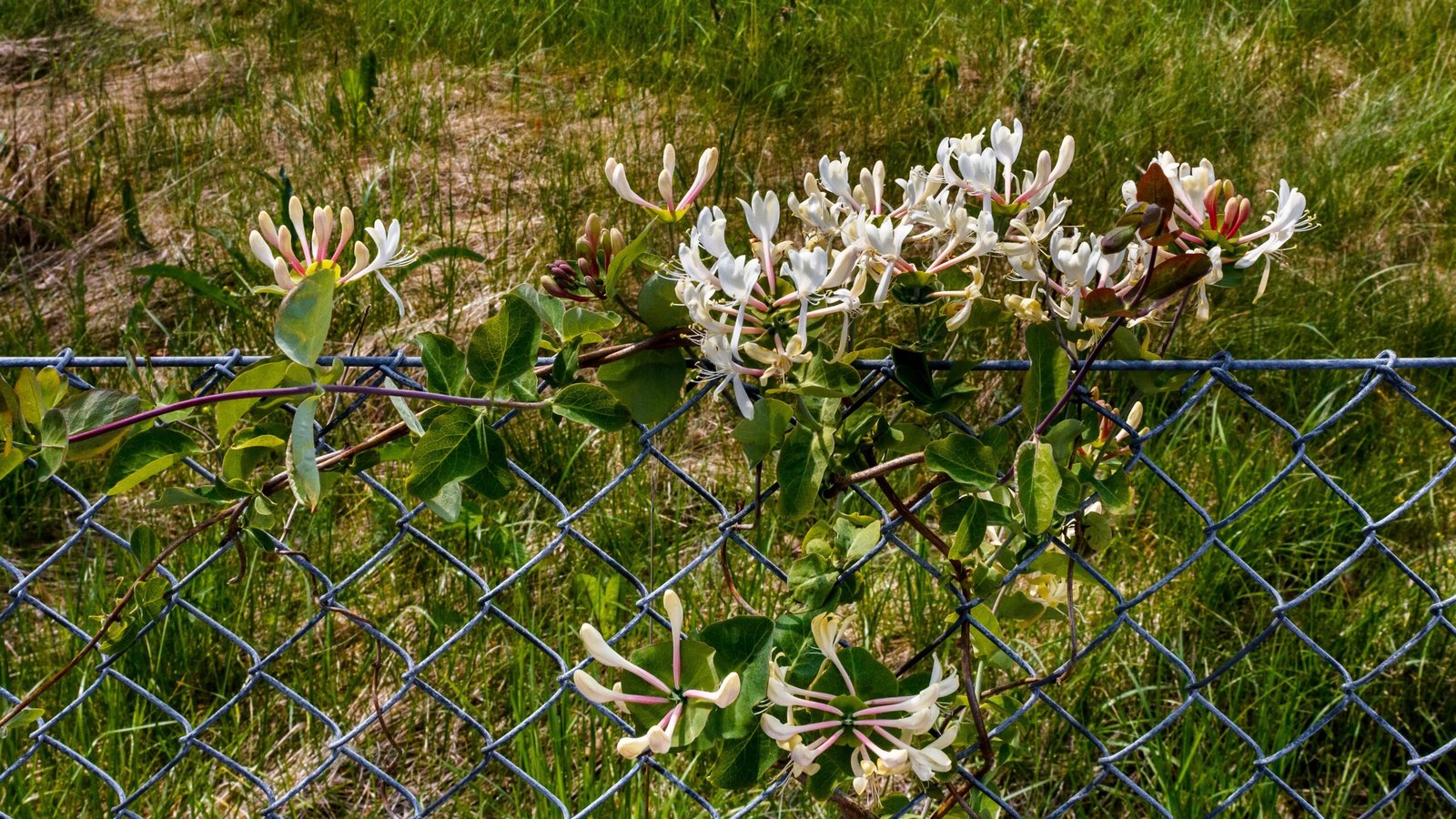
Honeysuckle is the cottage-garden favourite for good reason. It twines eagerly up wires or trellis, asks for little beyond a yearly tidy, and produces trumpet-shaped flowers with one of the finest scents in the garden, strongest at dusk when moths visit. Many varieties flower from early summer well into autumn, followed by berries that birds take in the colder months. In zones 5–9 most common honeysuckles are hardy, and they cope with partial shade better than roses or clematis, making them a kind choice for an east-facing fence.
One honest warning: avoid Japanese honeysuckle in regions where it is known to spread aggressively into wild areas. Named ornamental varieties and native types, where available, give you the scent and flowers without the worry, and planting in a garden border where you prune yearly keeps any honeysuckle mannerly.
Passion flower is the exotic of the group — intricate, sculptural blooms that stop visitors mid-sentence. The hardy blue passion flower does well in zones 7–10, and in zone 6 with a sheltered fence and a deep winter mulch. It climbs by tendrils, grows fast in a warm summer, and may die back to the ground in a cold winter before reshooting late in spring, so do not dig it up in April assuming the worst. Give it wires to grip, a sunny fence, and room to spread.
Both plants pull serious weight for wildlife. If that matters to you, it is worth thinking of the fence as one part of a wider planting scheme — a border designed as one of the best plants for a pollinator garden at the fence’s feet, with climbers above, gives bees and butterflies food and shelter at every height.
Sweet Peas, Morning Glory, and Other Fast Annual Climbers
Perennial climbers take time to build their framework, and that is where annuals shine. Sown in spring, sweet peas, morning glory, and nasturtiums can race up a fence in a single season, filling the gaps while your clematis and roses settle in. They are also the cheapest experiment in this guide: a packet of seed buys you a whole summer of colour, and if the combination disappoints you, nothing permanent has happened.
Sweet peas are the most loved of the three, grown as much for scent as for looks. Sow them in autumn in mild zones 8–10 for the earliest flowers, or in early spring in zones 5–7, and give them netting or a wigwam of canes against the fence — their tendrils need something fine to curl around. Pinch out the growing tip when plants are a few inches tall to encourage side shoots, water in dry spells, and pick the flowers every few days. Picking is not just for the vase; it stops the plant setting seed, which is its signal to stop flowering.
Morning glory is simpler still: sow after the last frost where it is to grow, give it strings or wires, and stand back. Its heart-shaped leaves cover a fence quickly and the trumpet flowers open fresh each morning through summer. In warm climates it can self-seed freely, so pull unwanted seedlings in spring if you like your planting deliberate. Nasturtiums scramble rather than climb and will happily thread through a fence and the plants in front of it, with edible flowers and leaves as a bonus; they thrive on neglect and poor soil, and flower worse if you feed them kindly.
Annual climbers are also a kind way to test a fence before committing. Live with a wall of morning glory for one summer and you will know exactly how much shade, privacy, and colour you actually want — and where — before you plant anything permanent.
Ivy, Virginia Creeper, and Self-Clinging Plants — With Warnings
Self-clinging climbers are tempting because they need no wires, no tying in, and no help at all. They are also the plants most likely to cause regret, so they deserve an honest section rather than a sales pitch.
Ivy clothes a fence in evergreen green all year, shelters birds, and flowers late in the year when pollinators need it most. On a sound fence in good condition it can be a genuine asset. The problems come with its strength and persistence: it will work its way through small gaps, prise at loose panels, add considerable weight and wind resistance to an old fence, and root wherever a stem touches soil. Once established it is hard work to remove, because the aerial roots leave marks and the plant reshoots from any fragment left behind. Plant it only where you are sure you want it permanently, and cut it back from the top of the fence each year so it does not form a heavy, sail-like mass.
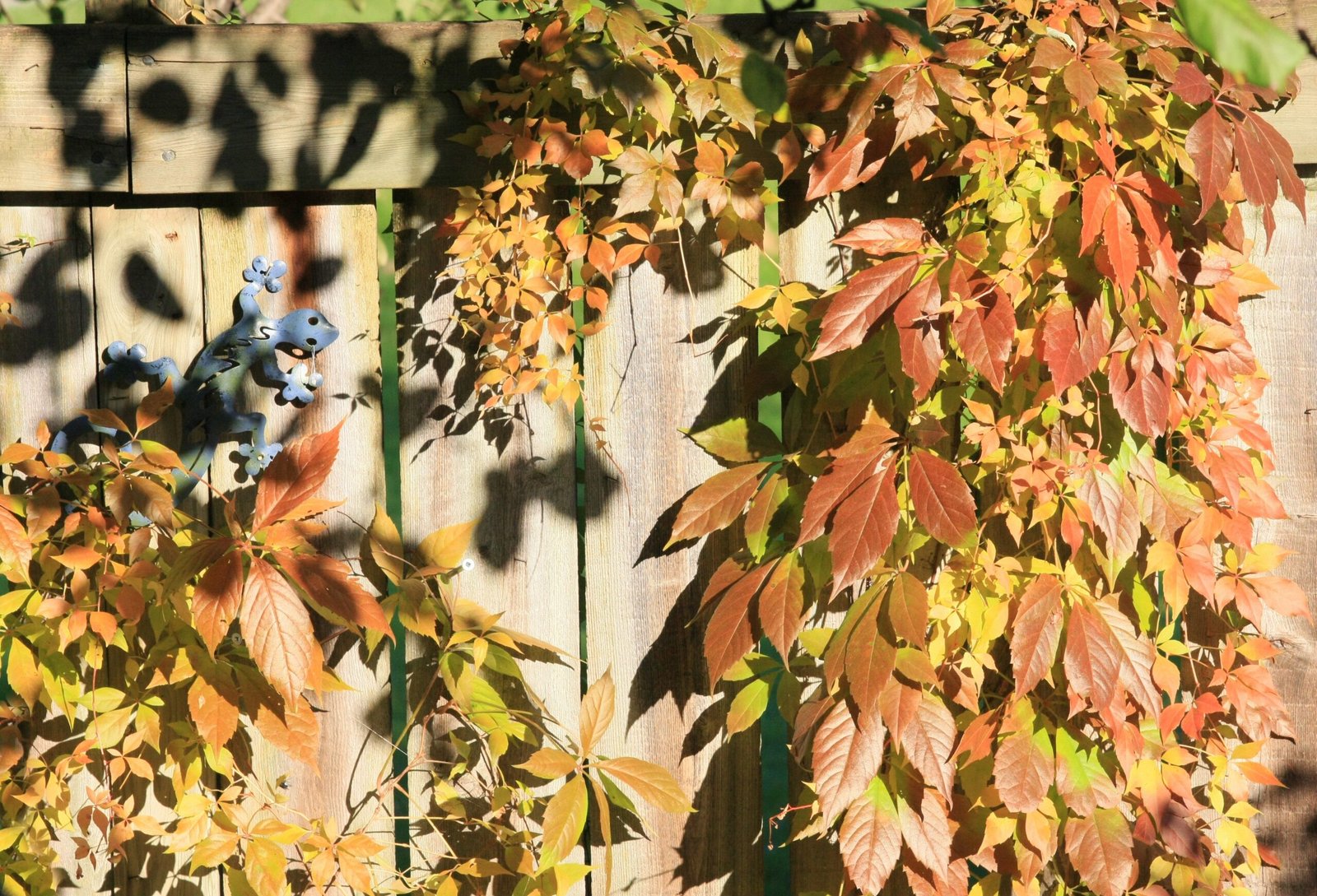
Virginia creeper is deciduous and grown for one glorious fortnight in autumn, when its leaves turn scarlet and crimson. For the rest of the year it is a vigorous green curtain — and vigorous is the operative word. In zones 4–9 it can cover a large fence quickly and will need firm annual pruning to stay within its allotted space. Boston ivy behaves similarly, with neater, three-lobed leaves. Both are excellent on a long boundary fence at the end of a garden and poor choices for a short fence between two small plots, where diplomacy with neighbours comes into it. Always check whose fence it is and what grows on the other side before planting anything that does not understand boundaries.
How to Plant and Train Climbers on a Fence
Good planting matters more than almost anything that follows. The soil at the base of a fence is often the driest, poorest in the garden — fences and walls create a rain shadow, and the ground is frequently full of rubble and old roots. Dig your planting hole at least eighteen inches away from the fence itself, in improved soil, and lean the young plant back towards its support on a cane. That small distance from the panel keeps the roots where rain actually lands and makes the first season far less thirsty.
Dig a hole roughly twice the width of the pot, mix the removed soil with garden compost, set the plant at the depth its group prefers — deeper for clematis, level for most others — and water in deeply, even if the soil feels damp. Mulch with a few inches of compost or bark, keeping it just clear of the stems, and then water weekly through dry spells in the first year. Most climber failures are first-year failures: the plant was left to fend for itself before its roots had explored beyond the original potful of compost.
Fit your supports before or just after planting, not once the plant is already flopping. Galvanised wires strung horizontally on vine eyes screwed into the posts are the sturdiest and least visible option, and they suit twining and tied plants alike. Trellis panels fixed on battens, so air circulates behind them, suit tendril climbers and make later fence maintenance possible — a detail worth having the first time a panel needs replacing.
Training is a little-and-often job. Every few weeks in the growing season, walk the fence with soft ties in your pocket. Spread new stems out sideways to fill bare patches, tie them in loosely in a figure of eight so the tie does not cut in as the stem thickens, and guide twiners gently towards their wires rather than yanking them into place. Five minutes regularly beats an hour of wrestling with a tangled plant in September. The goal is even coverage from ground level up, because a climber left alone will always race to the light at the top and leave you a bare fence with a leafy hat.
Practical Tips for Fences That Look Good All Year
Combine plants with different seasons on the same run of fence. A spring clematis through an evergreen jasmine, a summer rose alongside a late clematis, Virginia creeper behind them for autumn — layered like this, no month is dull, and no single plant has to do all the work.
Underplant the base. The bottom foot of a mature climber is often bare stems, and a row of hardy geraniums, spring bulbs, or low lavender along the fence hides it completely while shading clematis roots and suppressing weeds at the same time.
Feed and mulch in spring, once a year, without fuss. A bucket of garden compost or well-rotted manure spread around the base in early spring, followed by a general feed if growth is pale, is enough for most garden climbers. Container-grown climbers against a fence are the exception — they need regular feeding and watering all season, because a pot restricts roots in a way open ground never does.
Keep a pruning calendar, even a rough one. Most climbers need one proper prune a year, and nearly all pruning regret comes from cutting at the wrong moment. When you buy a plant, note its pruning time on the label or your phone there and then. Spring flowerers are tidied after they bloom; summer and late flowerers are generally cut back in late winter. Ten minutes with sharp secateurs at the right time keeps a fence plant productive for decades.
Check ties and supports every autumn. Stems thicken quietly, and last year’s loose tie can become this year’s strangling wire. Replace tight ties, make sure wires are still firm in their posts, and cut out any dead wood while you can still tell it apart from live growth.
Common Mistakes and Problems, and How to Avoid Them
Planting too close to the fence is the classic beginner error. In the dry rain shadow at the panel’s base, a young climber struggles from its first week, and gardeners often blame the plant. Move it out, water through the first season, and most “difficult” climbers turn out to be easy.
Choosing a giant for a small fence comes a close second. A vigorous rambler or wisteria on a twelve-foot run of panels means heavy pruning forever, and eventually resentment on both sides of the fence. Match the plant’s eventual size to the space when you buy it; the label’s height figure is the one piece of information worth trusting completely.
Letting everything grow straight up leaves the top crowded and the bottom bare, and with roses it also means few flowers. Train sideways from the start, while stems are young and bendable. Retraining a five-year-old woody stem is somewhere between difficult and impossible.
Neglecting shade-tolerance is another quiet cause of failure. A sun-loving clematis planted on a north-facing fence may live, but it will flower sparsely and stretch weakly towards the light. The plant is not sulking; it is simply in the wrong place, and swapping it for a honeysuckle or climbing hydrangea solves the problem at a stroke.
Watch for the common pests and diseases without panicking about them. Aphids cluster on soft tips in spring and can usually be blasted off with water or left for ladybirds. Powdery mildew appears on honeysuckle and clematis in dry summers — improve air flow, water at the base, and prune out the worst growth. Slugs and snails target young shoots in spring, especially clematis, so check new growth on damp evenings during the first weeks. A climber that is planted well, watered in its first year, and pruned on schedule shrugs off most trouble on its own.
Frequently Asked Questions
What is the fastest-growing climbing plant for a fence?
For quick permanent cover, Virginia creeper, many honeysuckles, and the blue passion flower are among the fastest in a warm, sunny spot, often putting on several feet in a season once established. For speed in a single summer, annuals win outright: morning glory and sweet peas can cover a fence from seed in one season, though they die back in winter.
Which climbing plants keep their leaves in winter?
Star jasmine, ivy, and evergreen honeysuckle are the most useful evergreen choices for fences. Star jasmine suits zones 8–10 and sheltered spots in zone 7; ivy and evergreen honeysuckle cope with colder conditions. In very cold climates, no broadleaf evergreen climber is fully reliable, and many gardeners accept a deciduous fence in winter and enjoy the spring regrowth instead.
Can I grow climbers on a fence without damaging it?
Yes, if you choose the right support. Wires on vine eyes, trellis on battens, and mesh panels all hold twining, tendril, and tied plants clear of the fence itself, and they let you paint or replace panels later. Self-clinging plants such as ivy are the ones that mark and prise at fencing, so use those only on sound fences you are happy to commit to them.
How far from the fence should I plant a climber?
About eighteen inches is a good general rule. It puts the roots where rain reaches, away from the dry, rubble-filled soil at the base of most fences. Angle a cane from the planting hole back to the fence so the young stems find their support straight away.
What can I plant on a shady fence?
Climbing hydrangea is the standout flowering climber for shade, once established. Honeysuckle flowers reasonably in partial shade, ivy thrives in full shade, and several clematis, particularly the spring-flowering alpine types, cope with a few hours of sun. On a deeply shaded fence, foliage and texture will always outperform flowers, so choose accordingly.
How do I stop a climber annoying my neighbours?
Prune it once a year back to your side, keep it from seeding or rooting over the boundary, and talk before you plant anything very vigorous. Tying growth in on your own side and cutting back stems that reach the top of the fence keeps most climbers neighbourly, and a plant kept within its space rarely causes friction.
Final Thoughts
Covering a fence is one of the most satisfying jobs in a garden because the change is so visible and so lasting. One plant, well chosen and trained sideways from the start, will give you flowers, scent, privacy, and wildlife value for decades — far more than the strip of soil it occupies has any right to produce.
Start with the fence you actually have: note its sun, fit honest supports, and pick a climber whose size and habits match both. Plant it a little way out from the panels, water it faithfully for one season, and keep a few ties in your pocket as you pass. Within two or three summers, that plain boundary will be the backdrop everyone asks about, and you will wonder why you ever left it bare.