Best Drought Tolerant Plants for Gardens
If you are looking for the best drought tolerant plants for gardens, you are probably tired of watching beds wilt every time the rain stays away for a couple of weeks. You are not alone. Hotter, drier spells, hosepipe restrictions in some areas, busy schedules, and thin or sandy soils all make regular watering harder than it used to be. The good news is that a garden that needs less water does not have to look sparse, dusty, or dull.
Some of the most beautiful garden plants evolved in places where rain is scarce and summer sun is relentless — the dry hills around the Mediterranean, the prairies of North America, the steppes and rocky slopes where only tough plants survive. Those plants bring colour, scent, texture, and wildlife value to an ordinary garden, and once they are established they ask for very little in return.
Drought tolerant does not mean no water ever, and it does not mean cactus-only planting unless that is the look you love. It means choosing plants that, after a first season or two of careful watering while their roots go deep, can cope with dry periods without collapsing. Get the planting and the soil preparation right, group plants with similar needs together, and you will water less, worry less, and still have beds that look full from spring to autumn.
Read the Leaves: How to Spot a Drought-Tolerant Plant
Gardeners use a few phrases loosely, so it helps to be clear at the start. Drought tolerant plants can survive a dry spell once established, though they may stop flowering, drop a few leaves, or look a little tired until rain returns. Drought resistant is sometimes used for plants that keep looking reasonably good through dry weather. No garden perennial, shrub, or tree is truly drought proof in its first year, because a young plant in a small pot has a small root system and dries out quickly.
Look at the leaves and you can often guess how a plant copes. Silvery or grey leaves, like those of lavender and lamb’s ear, reflect strong sun. Small, narrow, or needle-like leaves lose less water than big soft ones. Hairy leaves, waxy coatings, fleshy leaves that store water, and deep taproots are all survival tricks. Plants with large, lush, thin leaves — hostas in full sun, for example, or thirsty annual bedding — are usually the first to suffer. The Royal Horticultural Society makes the same point in its guide to drought-resistant plants: silver or grey-green leaves reflect harsh sun, and fine hairs on leaves or stems help trap moisture around the tissues.
Your own conditions matter as much as the plant label. A lavender that thrives in zones 5–8 on sharp-draining soil in full sun may rot over winter in heavy, wet clay in a colder, wetter spot. Drought tolerance and winter wet are two different tests, and many sun-loving dry-garden plants pass the first and fail the second. When you shop, check hardiness for your zone, sun needs, and drainage needs together, not just the words drought tolerant on the tag.
The Shopping List: Plants That Earn Their Place
Here is the short list, with the zones that matter, so you can shop with a plan instead of a hope.
| Plant | Zones | Best for |
|---|---|---|
| Lavender (English, ‘Hidcote’, ‘Munstead’) | 5–8 | Sunny borders, scent, bees |
| Coneflower (Echinacea purpurea) | 3–8 | Long summer colour, birds on seed heads |
| Yarrow (Achillea) | 3–9 | Poor soil, long flowering, big dry borders |
| Salvia (hardy perennial types) | Varies | Upright spikes, pollinators, repeat flowering |
| Gaura (Oenothera lindheimeri) | 5–9 | Light, airy movement, self-seeds gently |
| Russian sage (Perovskia) | 5–9 | Late-summer blue clouds on silver stems |
| Catmint (Nepeta) | 4–8 | Edging, softening paths, bees |
| Rosemary | 8–10 (sheltered 7) | Evergreen structure, kitchen herb |
| Cistus (rock rose) | 8–10 | Hot, poor, dry ground |
| Ceanothus (California lilac) | 7–10 | Spring blue flowers, sun, drainage |
| Sedum ‘Autumn Joy’ | 3–9 | Late flowers, bees, almost no feeding |
| Hens and chicks (Sempervivum) | 3–8 | Pots, troughs, rock gardens |
| Ice plant (Delosperma) | 5–7 (hardier types) | Sheets of bright flowers on hot ground |
| Olive tree | 8–10 | Mild zones outdoors; large pot elsewhere |
| Crape myrtle (Lagerstroemia) | 7–10 | High-summer flowering small tree |
Flowering perennials: the backbone
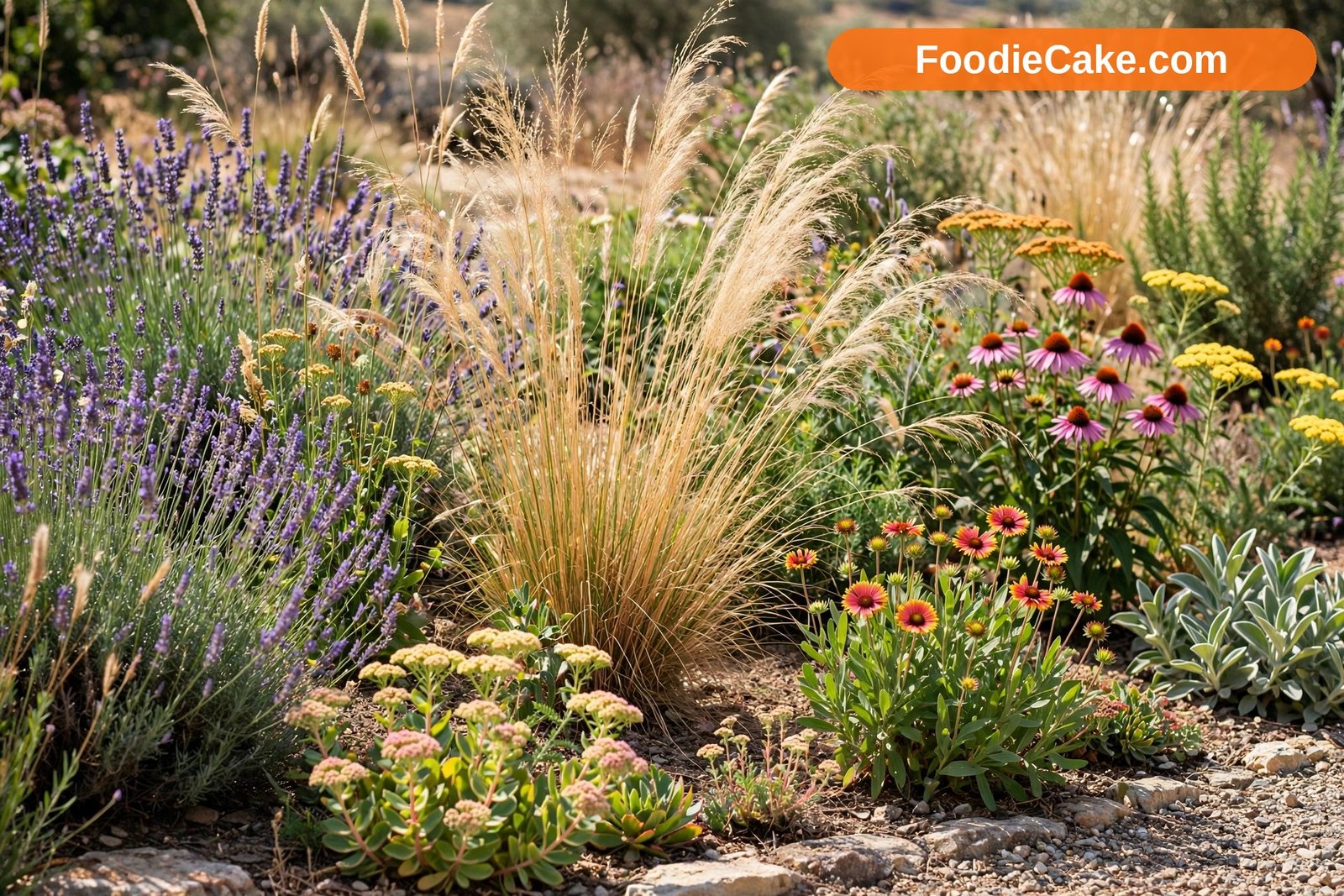
Perennials are the backbone of a low-water border because they return year after year and, once settled, develop the deep roots that carry them through dry weeks. Lavender is the classic starting point, and for good reason. English lavender, Lavandula angustifolia, and its cultivars such as ‘Hidcote’ and ‘Munstead’ are hardy in zones 5–8 in many gardens, flower in early to midsummer, smell wonderful, and draw bees all day long. Give it full sun, lean soil, and a trim after flowering, and do not overfeed it — rich, wet soil shortens its life far more quickly than drought does.
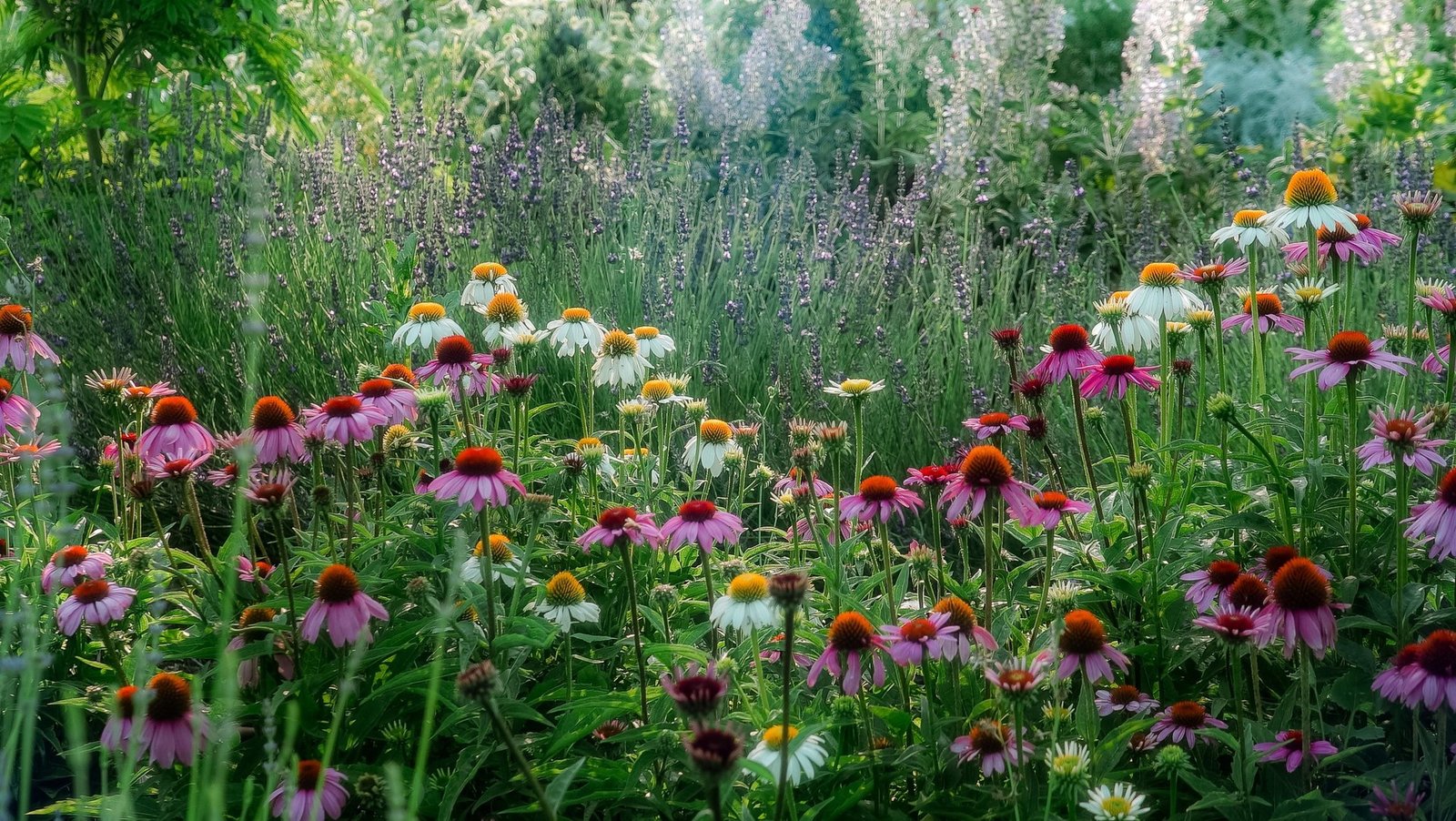
Coneflower, Echinacea purpurea, brings a completely different shape: bold, daisy-like flowers with a raised centre, in purple-pink, white, and newer warm shades, flowering from midsummer into autumn in zones 3–8 for many varieties. Birds visit the seed heads if you leave them standing. Echinacea dislikes winter wet, so drainage matters, but in summer dry spells it is remarkably steady once established.
Yarrow, Achillea millefolium and its hybrids, has flat heads of tiny flowers in yellow, terracotta, red, and soft pink above feathery foliage. It flowers for a long stretch, copes with poor soil, and is hardy across a wide range, often zones 3–9 depending on the cultivar. Deadhead to extend flowering, and be aware that some yarrows spread — which is a virtue in a large dry border and a nuisance in a tiny one, so check the habit before you buy.
Salvias deserve a place in almost every dry garden. Hardy perennial salvias such as Salvia nemorosa ‘Caradonna’ give upright spikes of deep violet flowers in late spring and again if you cut them back. Larger shrubby salvias are tender in colder zones, so treat the hardiness label seriously. All of them love sun, attract pollinators, and dislike sitting wet in winter.
Gaura, now often listed as Oenothera lindheimeri, adds lightness that heavier perennials lack. Its slender stems carry white or pink butterfly-like flowers for months, from early summer well into autumn, and it sways in the slightest breeze. It is often hardy in zones 5–9, can be short-lived, but frequently self-seeds gently where it is happy. Russian sage, Perovskia atriplicifolia, now also classified as a salvia by many botanists, gives late-summer clouds of lavender-blue flowers on silvery stems and is at its best exactly when many borders start to fade.
Do not overlook catmint, Nepeta varieties, for edging and softening paths. It makes billowing mounds of blue flowers, tolerates dry soil once settled, and if you shear it after the first flush it often flowers again. Bees love it, and so, fairly often, do cats.
Shrubs and herbs: structure plus scent
Shrubs give a dry garden its structure in winter, when perennials have died back, and the Mediterranean herbs earn their keep twice — once in the border and once in the kitchen. Rosemary is both. A mature rosemary bush in zones 8–10, or in a sheltered spot in zone 7, can become a substantial evergreen shrub with blue flowers in spring. In colder zones, grow it in a large pot you can move under cover, or accept it as a plant you may need to replace after a severe winter. It needs sun and sharp drainage and hates wet roots.
Cistus, the rock rose, is made for hot, poor, dry ground. These evergreen shrubs produce a succession of papery flowers in white and shades of pink through early summer — each flower lasts a day, but there are so many that the display goes on for weeks. Hardiness varies, with many types suited to zones 8–10 and the hardiest coping in sheltered zone 7 gardens. They dislike hard pruning into old wood, so plant them where they have room to reach their natural size.
Ceanothus, California lilac, covers itself in blue flowers in spring or early summer and thrives in sun on well-drained soil. Many varieties are hardy in zones 7–10, though exposure and winter wet make a difference. Like cistus, it resents heavy pruning and root disturbance, so choose the final spot carefully.
For scent and silver foliage, consider curry plant, Helichrysum italicum, and cotton lavender, Santolina chamaecyparissus. Both make neat, aromatic mounds for edges and gravel gardens, both want sun and drainage, and both benefit from a light trim to keep them compact. Sage, Salvia officinalis, and thyme belong here too: culinary sage makes a handsome grey-green shrub, and creeping thyme can soften steps and path edges while coping with very thin, dry soil — as long as feet and paws are its main traffic, not cars or constant heavy use.
If you have space for something larger, oleander is a familiar sight in hot, dry climates in zones 8–11, but it is poisonous in all parts and is not frost hardy in cold regions, so it is a pot plant to overwinter indoors for many gardeners. Mention it with that caution, choose it only where children and pets can be kept away, or skip it in favour of safer shrubs. There are plenty of good choices without added risk.
Grasses, ground cover and succulents: movement and texture
A dry border of flowers alone can look flat. Grasses add movement, ground cover suppresses weeds and shades the soil, and succulents bring shapes nothing else provides. Among ornamental grasses, Mexican feather grass, Nassella tenuissima, also sold as Stipa tenuissima, makes soft, hair-like mounds that catch the light and move constantly. Blue fescue, Festuca glauca, forms small blue-grey tufts that are perfect for edges and gravel. Larger grasses such as Miscanthus need more moisture while establishing and are better in zones with reasonable rainfall, so for genuinely dry ground the smaller, tougher grasses are usually the safer bet. Leave grasses standing through winter for structure and shelter for insects, then cut them back in early spring before new growth starts in earnest.
Sedums, now often listed under Hylotelephium for the upright types, are among the most reliable dry-garden plants of all. Upright forms such as ‘Autumn Joy’ give late-summer flat heads of pink flowers that age to rusty red and feed bees when little else is out, hardy in zones 3–9 for many cultivars. Low, creeping sedums carpet hot edges, walls, and green roofs, storing water in their fleshy leaves. They need sun and drainage and almost no feeding.
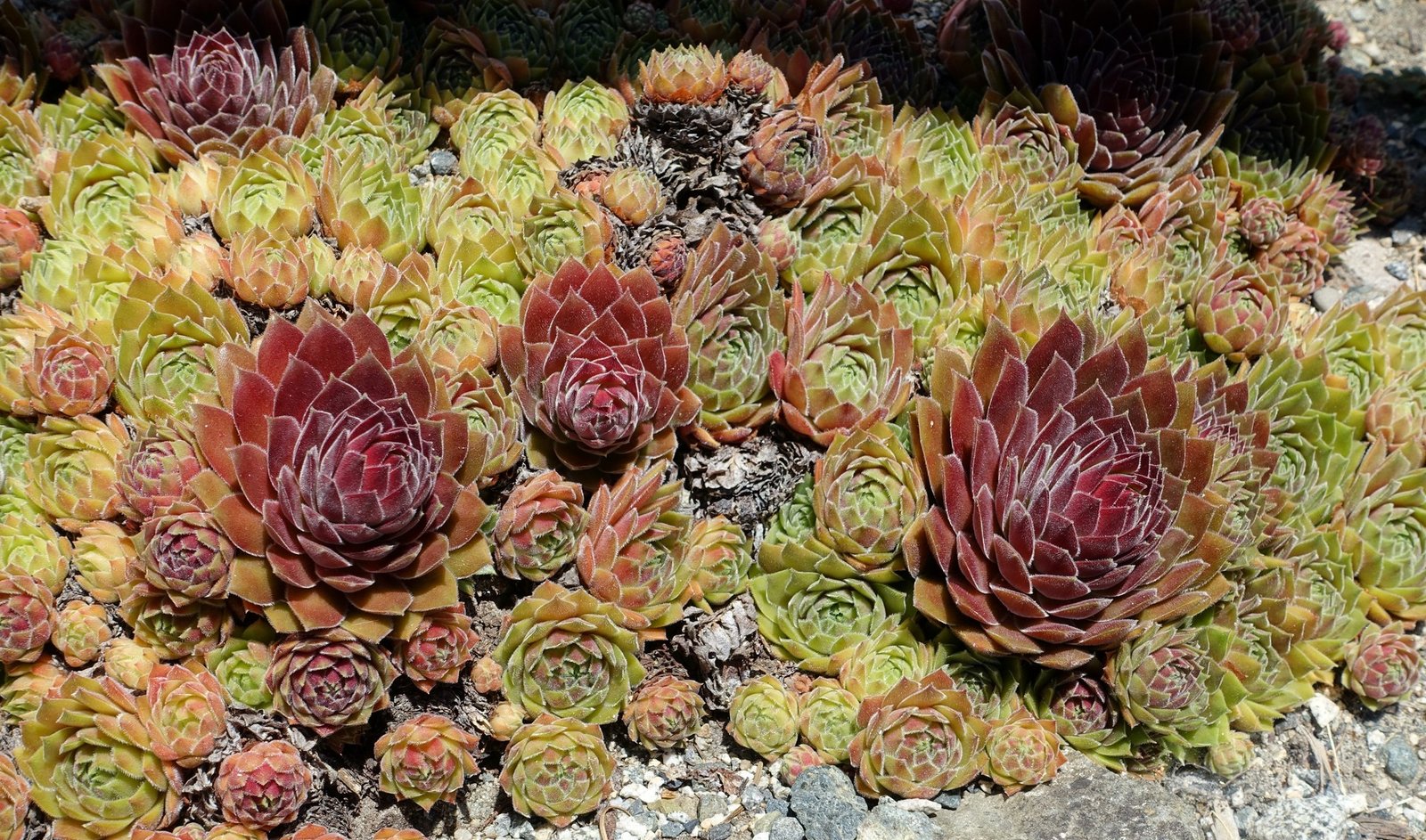
Creeping thyme, lamb’s ear (Stachys byzantina), and low-growing campanulas all work as living mulch in sunny dry spots. Lamb’s ear has soft silver leaves children love to touch, though it can spread enthusiastically — give it room or edge it firmly. Hens and chicks, Sempervivum, are near-indestructible in pots, troughs, and rock gardens in zones 3–8 and beyond, as long as winter water can run away from their rosettes. In the ground in wet-winter areas they rot; in a gritty pot they thrive for years with almost no attention.
Ice plant, Delosperma, gives sheets of bright daisy flowers in hot, dry places and is a star in zones 5–7 for the hardier types, though again drainage decides its fate in winter. Pairing these ground-hugging plants with taller perennials is also what makes a border read as one of those low-maintenance garden plants schemes that largely looks after itself after the first year.
Small trees and pots: the thirsty corners, tamed
Drought tolerant planting is not only for big borders. Some small trees cope well once their roots are deep, and pots — usually the thirstiest part of any garden — become far more manageable with the right choices. Olive trees are hardy only in milder zones, roughly zones 8–10 outdoors year-round, but in a large pot they can be moved to a sheltered spot for winter in cooler areas. Crape myrtle, Lagerstroemia, is a superb small flowering tree or large shrub for zones 7–10, flowering in high summer when few trees do, and tolerating heat and dry spells well once established. Eastern redbud, Cercis canadensis, in zones 4–8, is tougher than its delicate spring flowers suggest, though it appreciates water while young. Desert willow is excellent in the hot, dry Southwest in zones 7–11 but is not a plant for cold, wet winters. As always, the zone and the drainage matter more than the advertising.
For pots, choose plants that forgive an occasional missed watering: pelargoniums (the zonal geraniums of summer pots), portulaca with its jewel-bright flowers opening in sun, gazanias, lavender in a gritty mix, rosemary, sedums, and sempervivums. Use a loam-based or gritty compost rather than a very light mix that dries to dust, choose the largest pot you can manage because small pots dry out in hours, and stand pots together in summer so they shade each other’s roots. Even drought tolerant pot plants need water — a pot cuts roots off from the deep soil moisture that border plants can reach — but these choices widen the gap between waterings from a day to several days.
Where to Put Them: Sun, Soil and the Thirst Map
The best plant in the wrong place will still struggle. Most drought tolerant plants want full sun — six hours or more of direct sun a day — and soil that drains freely after rain. If water sits on the surface for hours, or the soil stays cold and sticky well into spring, improve drainage before you plant a whole border of Mediterranean herbs and grasses.
On sandy or gravelly soil you are already halfway there. The challenge there is the opposite in the first year: young plants dry out very fast, so you will need to water new planting thoroughly until roots spread. Adding well-rotted compost at planting time helps the soil hold a little more moisture and nutrients without making it heavy. On clay, avoid burying plants in a sump of compost in an otherwise solid hole, because water can collect there. It is often better to improve a wide area, work in grit or coarse organic matter across the bed, and plant slightly proud so the crown does not sit in winter wet.
Think in zones within your own garden. Put the toughest, sun-loving plants in the hottest, driest spots — against a south-facing wall, along a gravel path, at the top of a slope where water runs away. Save shadier, moister corners for plants that need them. This simple sorting saves more water than any gadget, and it echoes the way many people already plan their best plants for full sun gardens, by matching the plant to the brightest spot first and working from there.
Mulch helps too, but choose it to suit the plant. Gravel or stone mulch suits lavender, rosemary, sedum, and other plants that dislike wet crowns and enjoy heat reflected from the surface. A bark or compost mulch suits prairie perennials such as echinacea and rudbeckia, where it keeps moisture in and feeds the soil as it breaks down. Keep any mulch a little clear of stems and crowns so they do not stay damp and rot.
Planting Day and the Three-Year Promise
Here is the part that decides whether your dry garden succeeds, because most failures happen in the first season, not the third. Plant in spring in colder zones, once the soil is warming, so roots grow through summer; in mild, dry-winter regions autumn planting can work well because roots grow in warm soil while rain does the watering. In zones with cold, wet winters, spring is usually safer for Mediterranean plants.
Water the pot thoroughly before planting, dig a hole no deeper than the pot but wider, and tease out circling roots gently. Plant at the same depth the plant grew in its pot — burying the crown invites rot in many dry-garden plants. Backfill, firm lightly, and water deeply to settle soil around the roots.
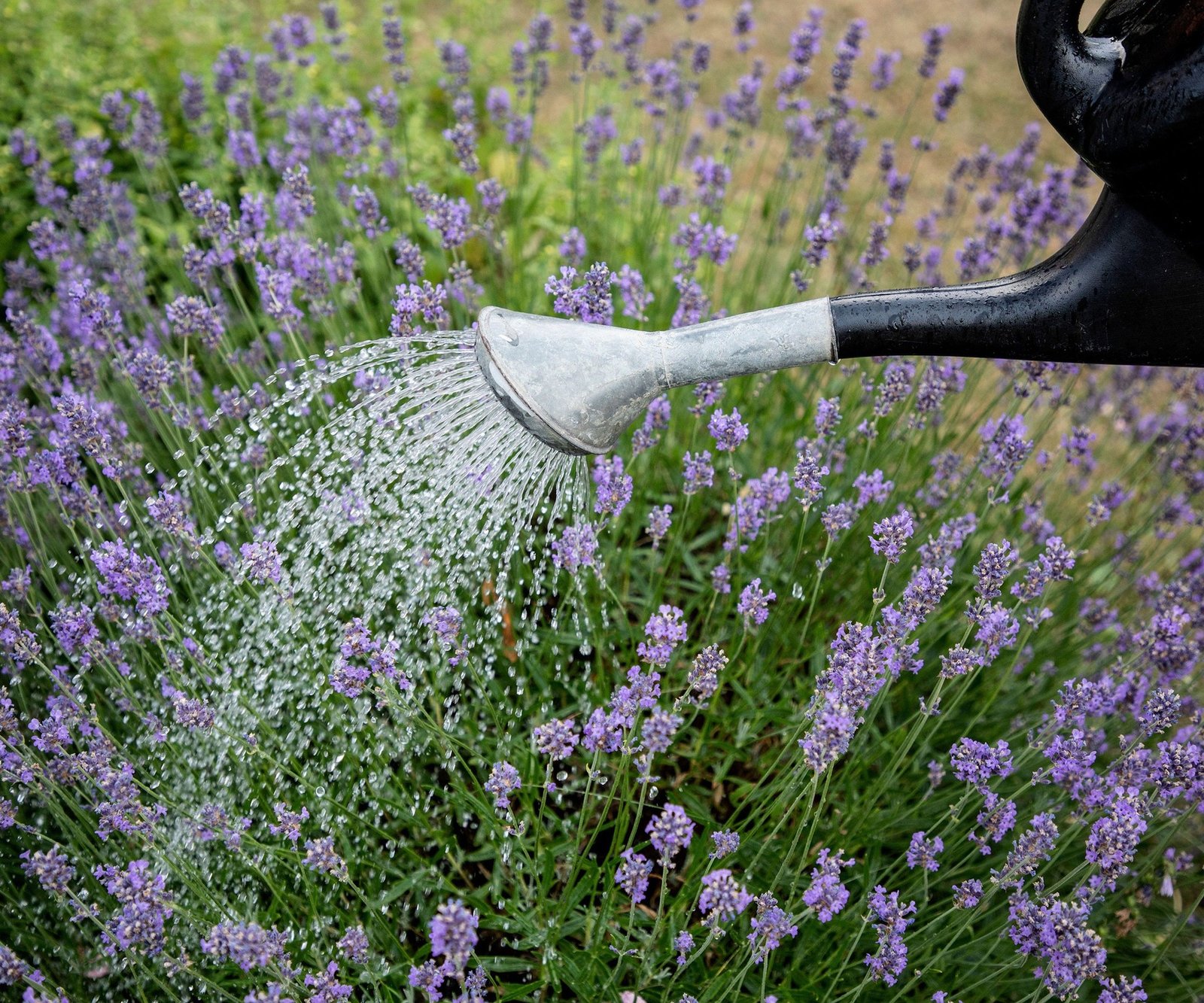
Then water deeply and infrequently, rather than a little every day. A thorough soak once a week in dry weather during the first season, adjusted for your soil and rainfall, encourages roots to grow downwards. Daily sprinkling keeps roots near the surface, exactly where soil dries first. By the second season most of these plants need water only in prolonged dry spells, and by the third many need none at all in a normal summer — though a deep drink during an exceptional heatwave is still kinder than watching them suffer on principle.
Keep the area around young plants free of weeds, which compete for every drop, and mulch after planting once the soil is moist. If a plant wilts in the afternoon but recovers by morning, it is often coping rather than dying; persistent wilting, crisping leaves, and dry soil several centimetres down are the signals to water.
The Water-Wise Habits
Group by thirst. Put plants that need occasional summer water in one bed and the truly tough ones in another, so you never have to water a whole border for the sake of two thirsty plants.
Water early in the morning when you do water, so less is lost to evaporation and foliage dries quickly. Water at the base of plants, not over the top, and aim for a slow, deep soak. Drip lines and soaker hoses suit dry borders well, but check them occasionally — a blocked emitter means one plant quietly goes without.
Improve one bed at a time rather than trying to transform the whole garden in a season. A single successful dry border teaches you what works in your soil and microclimate, and those lessons transfer.
Choose fewer, bigger groups. Drifts of five or seven of one perennial look better, pollinators find them more easily, and their roots and foliage shade the soil together. Single specimens dotted about rarely settle as well.
Leave seed heads and grasses standing into winter where you can. They shelter insects, feed birds, look beautiful in frost, and protect crowns from the worst of the wet and cold. Cut back in early spring, just as growth restarts.
Keep a simple notebook or phone note of what thrived, what sulked, and what died over winter. Winter losses in dry gardens are usually about wet and cold, not summer drought, and a season’s notes will steer next year’s buying better than any catalogue. The RHS design for drought-tolerant pollinator plants shows the same thinking in practice: a planned combination of plants that thrive together in drought, flower across the seasons, and support pollinators while needing little water once established.
Five Expensive Assumptions
The biggest mistake is assuming drought tolerant means plant it and never water it. New plants die of thirst in their first summer more often than established plants die in a drought. Water through the first season, taper in the second, and only then rely on rainfall.
The second mistake is planting Mediterranean and silver-leaved plants in heavy, wet soil and blaming drought tolerance when they rot in January. If your soil is clay, work on drainage across the bed, add grit, plant on a slight mound, and use gravel mulch around crowns — or choose prairie plants such as echinacea, rudbeckia, and baptisia, which tolerate clay better while still coping with dry summers once settled.
Overfeeding is a quiet problem. Rich soil and high-nitrogen fertiliser push soft, lush growth that needs more water and flops in wind. Most dry-garden plants prefer lean soil. If growth is healthy and flowers come, leave the feed in the shed.
Planting in full summer heat is another avoidable setback. A plant put in during a heatwave needs constant attention just to stand still. Spring and early autumn planting, where your zone allows, gives roots an easier start.
Finally, do not crowd young plants based on their pot size. A small lavender may reach a metre across; a ceanothus can become a large shrub. Crowded dry gardens lose the air flow that keeps foliage healthy, and removing a mature, deep-rooted shrub later is hard work. Read the mature size on the label and trust it.
Quick Answers
Do drought tolerant plants need any water at all?
Yes, especially in their first year or two and in pots at any age. Drought tolerant means an established plant in the ground can get through dry spells without regular watering. It still needs deep watering after planting, during establishment, and in exceptional heat or drought.
What is the easiest drought tolerant plant for beginners?
Lavender, sedum ‘Autumn Joy’, catmint, and yarrow are all forgiving starting points in sunny gardens with reasonable drainage. Lavender needs the sharpest drainage; sedum is probably the most tolerant of ordinary garden soil. Start with two or three of these, learn how they behave in your garden, then expand.
Can I grow drought tolerant plants on clay soil?
Yes, but choose carefully and prepare the bed. Prairie-style plants such as echinacea, rudbeckia, liatris, and baptisia handle clay better than Mediterranean herbs. Improving drainage, planting slightly raised, and avoiding winter waterlogging matter more on clay than any particular product.
When is the best time to plant a dry garden?
In most colder and temperate zones, spring is safest, because plants establish through the growing season before their first winter. In mild zones with dry summers and wetter winters, early autumn planting also works well and lets winter rain settle plants in. Avoid planting in the middle of a heatwave if you can.
Will a drought tolerant garden still attract bees and butterflies?
Very much so — many of the best pollinator plants are drought tolerant ones. Lavender, salvias, echinacea, yarrow, sedum, thyme, and ornamental grasses for shelter all draw bees, butterflies, and hoverflies through a long season, especially if you let some flowers go to seed.
A Garden That Drinks Less
A garden that needs less water is not a compromise. At its best it is scented, colourful, full of bees, and interesting in every month of the year — and it frees you from dragging a hose around on every warm evening. The recipe is simple to say and satisfying to do: choose plants bred by dry places, match them to your sun and soil, water them properly while they are young, and then step back.
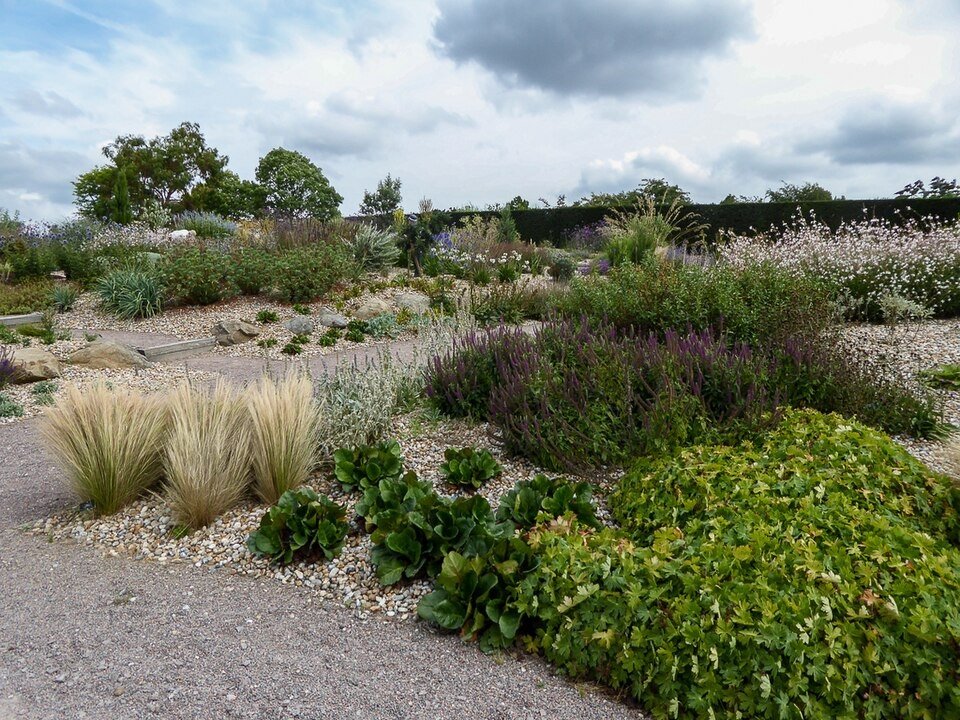
Start small if you need to. One sunny bed replanted with lavender, echinacea, yarrow, grasses, and sedum will show you within a single summer how generous a dry garden can be. Once you see those plants holding their own through a dry spell while the lawn turns pale, you will find yourself extending the idea, bed by bed, until watering becomes the exception rather than the routine.
Sources
- Royal Horticultural Society — Drought-Resistant Plants
- Royal Horticultural Society — Drought-Tolerant Pollinator Plants